
DEVELOPMENT PROGRAMME
Someland
Early Recovery Offer
A rapid, data-led early recovery proposal for a compounded seismic and access crisis — built around UNDP's 72-hour assessment tool, RAPIDA.

Context and Background
A dam at risk, militias on the roads, and a country that hadn't finished recovering from the last disaster.
Someland is facing a compounded crisis driven by seismic risk, infrastructure fragility, insecurity and restricted access. Morning tremors near Sim Sim have raised serious concerns over the stability of a dam considered unsafe, prompting evacuation orders and increasing the risk of downstream flooding, displacement, damage to agricultural land, disruption of basic services and contamination of water sources.
The crisis is unfolding in a country already exposed to recurrent floods, storms, droughts, landslides and earthquakes, with incomplete recovery from previous disasters and localized conflict. At the same time, armed militias have seized key transportation routes, hindering aid delivery, evacuation support, assessments and restoration of critical services.
The combined impact of dam failure risk, restricted humanitarian access and pre-existing vulnerabilities could rapidly deepen displacement, livelihood losses, public health risks and social tensions — and risks overwhelming local authorities and further weakening already-strained infrastructure.
Coordination Arrangements
Nationally led, UNDP-supported — no parallel structures.
The early recovery response will be nationally led by the National Disaster Management Agency (NDMA), with UNDP providing technical, coordination and advisory support. The arrangement will build on existing government systems and avoid creating parallel structures.
Coordination with the Government
NDMA is the main government entry point for early recovery. UNDP supports NDMA in bringing in relevant ministries depending on the nature and location of the crisis, and advocates for mayors and municipal heads to join sub-national coordination meetings.
UN System & Humanitarian Actors
UNDP ensures NDMA engages the UN Country Team, coordinates with OCHA and engages the Shelter and WASH Clusters, while also linking with Red Cross/Red Crescent components and major INGOs. WFP support for collective shelters will be flagged to the RC/HC.
RAPIDA: the 72-hour early recovery assessment
Powered by AI, deployed by the Crisis Bureau — insight before the PDNA process even starts.
RAPIDA is UNDP's rapid early recovery assessment tool, deployed by the Crisis Bureau's Assessments and Digital Solutions team. It builds on GIS tools (Geohub) and leverages satellite imagery, social media and night-light data to deliver real-time insight within 72 hours of a crisis — later deepened by key informant interviews (KIIs) over one to three weeks, covering infrastructure, livelihoods, energy, environment, governance and gender impact.
At the Herat earthquake in Afghanistan, RAPIDA helped UNDP narrow down affected locations for in-person assessment, saving time and surfacing data on hard-to-access areas — including estimates of damaged housing and debris tonnage. RAPIDA runs at no cost to the Country Office, covered under C3RT, and activates automatically whenever a crisis level is declared.
A competitive edge, not just a dataset
UNDP was left out of the initial World Bank/EU/NCCC call on the PDNA, informed only afterward. RAPIDA can be activated immediately, giving UNDP credible data and visibility within 72 hours — well before the PDNA process matures over its typical 1–3 month framework. That gives UNDP a concrete basis to engage in HCT, NCCC and donor discussions, rather than waiting to be invited in.
(HBDA / SEIA)
(PDNA / HBDA / SEIA)

Where RAPIDA looks first
Eight focus areas, each grounded in a number from the ground.
Debris estimation
An estimated 100–120M m³ of construction debris across five provinces. Remote sensing can quantify volume and location around Suri, Pari City and Helo Village without field access.
Community infrastructure
7,100 km of community roads, 520 bridges, and 35% of community buildings damaged — mapping which social and governance structures have been disrupted village by village.
Economic impact
78,000 farmers with unsalvageable seasonal crops, 60% of small businesses losing tools and equipment — capturing disruption before the slower PDNA delivers findings.
Gender impact
Women represent 70% of informal market vendors and 60% of tourism employment. KIIs with women's machineries and cooperatives surface impacts official reporting has missed, while monitoring rising SGBV risk.
Energy & environment
Hydropower capacity sharply reduced, shifting reliance to diesel and unsustainable timber harvesting — tracking degradation to support a lower-emission recovery pathway.
Displacement (IDPs)
250,000 displaced, including a 75,000-strong migrant population under temporary protection — tracking patterns and strain already generating friction with host communities.
Local governance functions
Government offices in 3 of 5 provinces severely damaged; 30% of staff and 38% of police not reporting to work. A natural UNDP entry point for restoration support.
Community security
Riots in Centre City, attacks on aid workers and accusations of exploited unrest among minority communities — informing conflict-sensitive, do-no-harm programming amid election-adjacent tension.
Deployed with the highest safeguards
In a context of ethnic tension and active misinformation, data itself becomes a protection issue.
Safeguarding personal data
Given ongoing civil unrest, ethnic tensions targeting the Jung, Bing, Hing and Sing communities, and a vulnerable migrant population under temporary protection, RAPIDA embeds privacy by design across all data collection — particularly KIIs involving ethnic minorities, women's groups and displaced populations. Informed consent is obtained from all respondents and data is fully anonymized before publication.
Upholding ethical standards
Data practices follow the UN Charter and international human rights frameworks, with particular attention to "do no harm" given the risk of inflaming ethnic tensions or fuelling opposition narratives ahead of provincial elections. All collection and analysis is designed to serve the public good and avoid reinforcing existing stigmatization.
How RAPIDA is implemented
From open-access data to validated, ground-level insight in three steps.
Identify affected areas
GIS and open-access data from UNOSAT, EU Copernicus, the Pacific Disaster Center, OpenStreetMap and UN-SPIDER pinpoint affected regions and districts immediately after the event.
Within 72 hoursEstimate impact on people & infrastructure
Population data (WorldPop/Meta) and building footprints (Microsoft/Google) are overlaid with OSM road and land-cover data to estimate affected people, buildings, roads and critical infrastructure, hosted on a shareable Geo-Hub.
Within 72 hoursKey informant interviews
Detailed information is gathered through KIIs with community, religious and traditional leaders, local officials, women's groups, ethnic representatives, and chambers of commerce — led by the CO with CB support.
1–3 weeksThe two components let UNDP move from a broad remote overview to a grounded, locally validated picture of early recovery needs within the first weeks of a crisis — laying the groundwork to activate Crisis Response Packages (CRP).
Additional digital tools in use
| Tool | Description | Accessibility | Managing team |
|---|---|---|---|
| Kobo Toolbox | Primary data collection, surveys — mobile & desktop | All UNDP, free | BPPS / SDGi |
| Survey123 | Primary data collection, surveys — mobile & desktop | ESRI creator/pro license | BMS / ITM GIS |
| Microsoft PowerApps | In-house primary data collection tool | All UNDP | ITM / SDH / CO |
| DFX — GIS Geo-Hub Portal | Data storage, visualization, open-source GIS analysis | Free, approved account | BPPS / SDGi |
| Power BI | Data visualization and analysis | All UNDP, free | BMS / ITM GIS |
| ArcGIS Products | GIS, data storage and visualization suite | ESRI creator/pro license | BMS / ITM GIS |
| MS Office 365 | Data cleaning, analysis, transformation, publication | Mostly free, some licensed | BMS / ITM GIS |
UNDSS restricts field access in high-risk mountain provinces (Sim Sim, Suri). Remote sensing should cover these areas first, while KIIs sequence in from safer zones like Helo, using trusted local enumerators such as Red Cross volunteers rather than UNDP staff. Findings should be framed as indicative and shared through UNCT/HCT channels first, avoiding politicization ahead of provincial elections.
Programmatic Framework
Five sectors, three phases, a combined $260 million envelope.
Restoring Local Governance
Confirm impacted areas, engage stakeholders, identify needs via RAPIDA/MIRA, restore police functions and women's protection mechanisms in shelters, assess Dam structural integrity, restore cell coverage and energy.
Health
Map stakeholders, confirm immediate needs, identify public health threats (AWDs, cholera, PTSD), procure medicines and trauma kits, run risk-communication campaigns, recruit Community Health Workers, explore drone-delivery partnership.
Energy
Assess affected sites and gendered energy impacts, design solutions by hot-spot and risk matrix, prioritize cooking, lighting, health and education facility needs.
Livelihoods
Field visits where access allows, value-chain assessment for cultural industries and agriculture, partner mapping, cash-for-work programmes for debris removal and facility cleaning.
Debris Management
Assess debris size, type and landfill capacity, identify transport routes, scope contracts, develop a PIP, identify health/security/legal risks.
Restoring Local Governance
Restore schools, health facilities, police stations and courts; design local rule-of-law and community policing programmes; support local CSOs and Local Peace Committees for social cohesion.
Health
Deploy mobile PHC clinics and DOCKTOUR containerized mobile hospitals at no cost; train health workers with WHO; design Smart Health Facility recovery blueprint; operationalize ambulances and supply chains.
Energy
Integrate energy into other sectors (mobile clinics, solar stations), establish mini-grids, build an implementation model and identify technical/financial resourcing and ownership.
Livelihoods
Deliver small-scale farming, livestock, women-led market vending, handicrafts, tourism-linked work and informal construction support across affected sectors.
Debris Management
Implementation with contractor engagement and partner management; deliver a communications strategy on areas addressed and complaint processes.
Restoring Local Governance
Comprehensive capacity building for local authorities; support police and judiciary recruitment/retention; establish Early Warning Mechanisms using GIS, mapping and AI.
Health
Develop a comprehensive, gender- and disability-inclusive health recovery plan; engage major donors (WB, IFIs, EU); design durable health waste management; support digital health services and BiMediX telemedicine integration.
Energy
Identify procurement, delivery and access risks; address exclusion of women from the energy sector; support sustainable energy policy and framework development.
Livelihoods
Support digital skilling for informal-sector workers, private-sector recovery engagement, and a Decent Jobs project with gender-conscious skilling and social protection access.
Debris Management
Strengthen national institutions (civil defence, municipalities) for long-term policy and resilience; conduct capacity-needs assessment for local institutions and communities.
Gender, Inclusion & Conflict Sensitivity
Three pillars run through every component of the offer — not bolted on at the end.
Gender Mainstreaming
Sex-, age- and disability-disaggregated data informs targeting given existing gaps in land ownership and economic participation. Particular attention to female-headed households, women with disabilities and women from minority communities. Women are actively engaged in planning and decision-making, with protection-sensitive design across all activities.
Inclusion
Recovery assistance is accessible, equitable and responsive to persons with disabilities, older persons, youth, female-headed households and minority communities. Disaggregated data identifies specific vulnerabilities; affected communities are engaged directly in planning so no one is left behind.
Conflict Sensitivity & Do No Harm
Given tensions between the Somese majority and mountain minority communities, recovery is guided by transparent targeting, inclusive consultation and regular conflict analysis — with feedback mechanisms to address perceptions of exclusion and strengthen social cohesion.
Communications and Advocacy
Positioning UNDP as credible and visible, while keeping messaging conflict-sensitive.
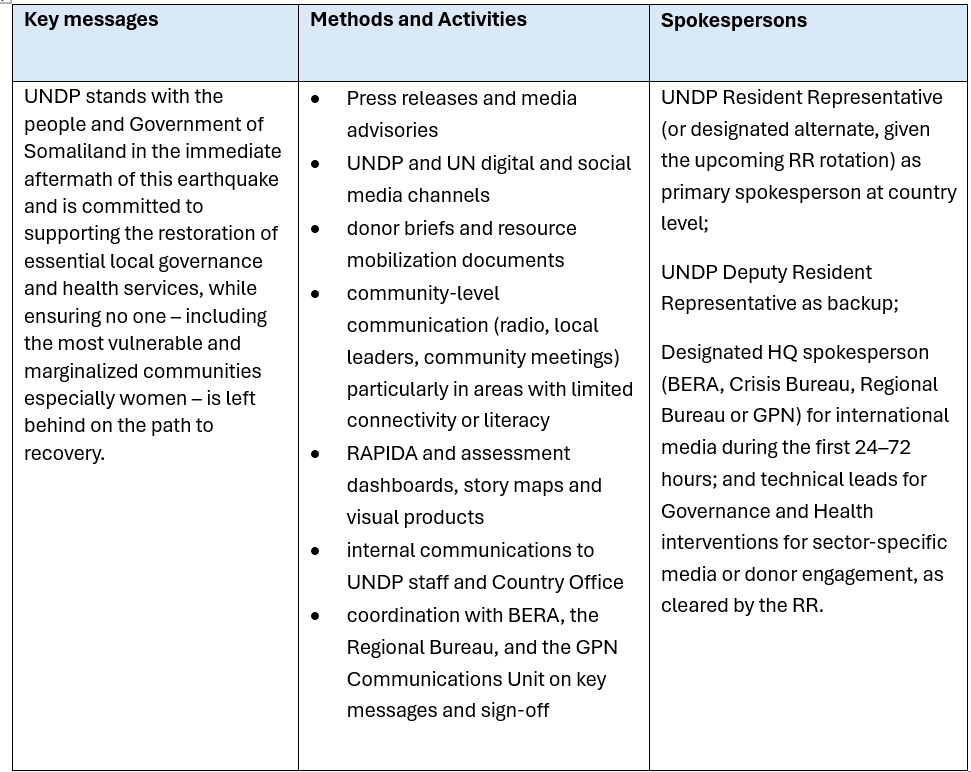
The plan supports the Local Governance and Health programmatic interventions across the 0–6, 6–18, and 18–48 month phases, building public trust, supporting resource mobilization, and ensuring transparent two-way communication with affected communities — including women, mountain minority groups and displaced populations.
Key audiences
Mountain minority groups — Jung, Bing, Hing, Sing — and displaced populations
Ministry of Interior, Ministry of Health, NDMA, provincial & municipal authorities
UNCT, HCT, European Union, World Bank, International Financial Institutions
National and international press
Staff and senior management
Women's organizations and youth-led organizations
Plan duration
Immediate response and stabilization
Recovery and institutional restoration
Sustained recovery and resilience-building
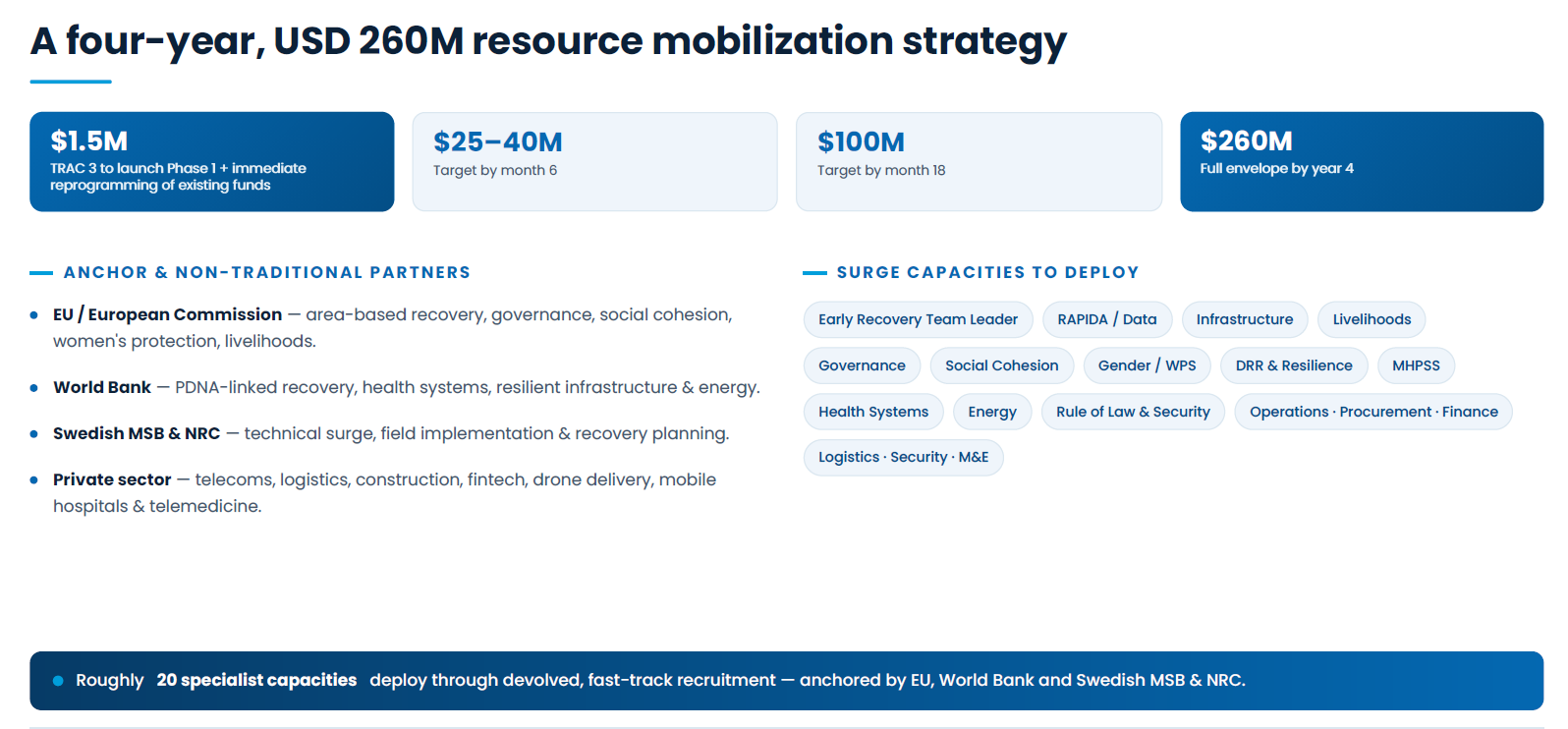
The team required to deliver the offer
Fifteen specialist roles spanning coordination, sectoral recovery, and cross-cutting protection.
Coordination Team Leader
Leads UNDP's response, engages NDMA, UNCT, HCT and donors; bridges humanitarian response and longer-term recovery.
Data Specialist
Analyzes assessment findings, supports GIS mapping, informs resource mobilization and programme design.
Infrastructure Recovery Specialist
Assesses damage and supports rehabilitation of schools, health facilities, roads, bridges, water and power systems.
Livelihoods Recovery Specialist
Designs employment and cash-for-work initiatives; supports women-led enterprises and tourism-linked livelihoods.
Governance Specialist
Strengthens provincial/local authority coordination and embeds recovery within existing institutions.
Social Cohesion Specialist
Ensures conflict-sensitive, inclusive assistance and supports local peace committees and dialogue.
Gender & WPS Specialist
Addresses needs of women and girls and promotes participation in recovery decision-making, alongside MHPSS.
DRR & Resilience Specialist
Integrates risk-informed approaches and Build Back Better principles across all interventions.
MHPSS Specialist
Integrates psychosocial recovery considerations into community-based interventions.
Agriculture Recovery Specialist
Assesses damage to agricultural assets, irrigation and livestock; restores production and food security.
Energy in Crisis Response Specialist
Assesses power infrastructure damage and supports restoration of resilient energy services.
Rule of Law & Community Security Specialist
Restores local justice and safety functions; strengthens authority-community collaboration.
Health Systems Recovery Specialist
Supports assessment and recovery of damaged health infrastructure and essential services.
Operations Coordinator
Coordinates field operations and business continuity across multiple simultaneous recovery activities.
Procurement, Finance & Logistics Specialists
Support timely procurement, financial oversight and movement of personnel and supplies to affected areas.
Security Advisor
Monitors developments and supports safe access amid militia-controlled transportation routes.
Programme Management Support
Coordinates planning, monitoring and reporting across recovery workstreams.
Communications & Partnerships Specialist
Leads strategic communications, stakeholder engagement and resource mobilization.
Monitoring & Evaluation Specialist
Tracks progress, measures outcomes and supports evidence-based decision-making.
Special Measures for Crisis Response
An initial six months of flexibility to bypass standard administrative delays.
The UNDP Someland Country Office requests immediate activation of the pre-approved Special Measures for Crisis Response, for an initial period of six months with possible extension — an operational necessity to empower the Country Office to rapidly deploy critical recovery resources.
Operational measures
| Category | Measure | Rationale |
|---|---|---|
| HR | Use of pre-classified generic JDs/ToRs for crisis response | An understaffed 20-person CO needs to onboard surge capacity in engineering, debris management and cash-for-work without classification delay. |
| HR | Devolved national recruitment (FTA/PSA) to local CO HR team | Accelerates hiring of national staff with essential local knowledge and language skills. |
| HR | RR direct recruitment for up to 20 TA positions (up to P5) | Enables immediate deployment of senior technical experts in governance and recovery planning. |
| Procurement | Direct procurement increased to US$15,000 | Allows immediate purchase of essential supplies from local vendors. |
| Procurement | Simplified RFQ for goods/services up to US$200,000 | Faster than standard RFQ amid collapsed supply chains and urgent shelter/sanitation needs. |
| Procurement | LTAs expiring within 6 months extended by 12 months | — |
| Finance | Petty cash increased to US$10,000 (US$1,000/transaction) | Enables on-the-spot payment for cash-for-work labour and urgent supplies in remote locations. |
| Finance | Project Cash Advance raised to US$50,000, 60-day reporting | — |
Programmatic measures
| Category | Measure | Rationale |
|---|---|---|
| NGO/CSO | Ad hoc NGO selection approval process for LVG | Funds local partners quickly to scale emergency livelihoods and community mobilization. |
| NGO/CSO | HACT micro-assessment requirement waived | Using PCAT screening instead allows rapid disbursement of funds. |
| NGO/CSO | Roster eligibility if contracted by a sister agency within 24–36 months | — |
| Private Sector | Due diligence authority delegated to RR up to US$1 million | Finalizes large-scale debris removal and reconstruction partnerships without delay. |
| Private Sector | "Basic" due diligence pathway for agreements ≤US$150,000 | Lets UNDP engage smaller, local enterprises efficiently. |
| Project Initiation | SES and quality-assurance procedures exempted for 12 months | Enables rapid PIP launch for critical activities. |
| Project Initiation | No threshold on LVG grants per programme cycle (US$150K/grant cap remains) | — |
| Project Initiation | Government agreement recommended, not mandatory, under DIM modality | — |
Risk Matrix
Eight risks, continuously monitored across operational, security, financial, environmental and social dimensions.
The recovery response will be implemented in a complex and evolving environment shaped by earthquake damage, continued aftershocks, access constraints and institutional capacity challenges. Particular attention is given to conflict sensitivity, inclusion, accountability and coordination to ensure interventions contribute to resilience and sustainable outcomes.
| Risk | Likelihood | Impact | Mitigation measure |
|---|---|---|---|
| Tensions between Somese majority and mountain minority communities rise over perceived inequities in recovery assistance | High | High | Apply conflict-sensitive programming and transparent selection criteria |
| Insecurity and restricted access from armed groups controlling transport routes | Very High | High | Work with government authorities to find alternatives and avoid delay |
| Continued aftershocks and secondary hazards | High | High | Conduct risk reduction measures |
| Misinformation and rumors undermine trust in recovery efforts | Medium | High | Conduct campaigns and establish feedback mechanisms |
| Funding gaps delay implementation of recovery interventions | Medium | High | Engage donors at early stages |
| Limited institutional capacity of local authorities delays planning and implementation | Medium | High | Provide technical assistance to local authorities and government |
| Women, persons with disabilities, minority groups and other vulnerable populations excluded from recovery benefits | Medium | High | Mainstream gender and inclusion across all interventions |
| Damage to critical infrastructure exceeds available recovery resources | High | High | Prioritize critical infrastructure, mobilize funding, coordinate with partners, phase reconstruction by urgency |